Thanks, little guy! Well, our biggest family hobby is model railroading. We model in N-scale and are involved in several clubs. The biggest is the NMRA, where we are involved in the local division as photo and model contest chairs (the Dad maintains the web site, but didn't design it). We travel to about 6 model train shows per year with our other club, the Capitol City N'Gineers (the Dad maintains this site too, and did design it. Nuf said - needs updating). CapCity specializes in building and displaying N-scale modules following the NTrak standard. A few modules owned by the club are stored in our basement, and many more are built and owned by individual members. Some of our members (like us) are working on home layouts as well.
So, basically, we take the modules and equipment to a high school gym, convention center or other large room and spend about 6 hours setting them up. Then we spend two days running our trains around on them, looking at other train layouts, buying train stuff, and talking to the public about trains. Then the tear-down and loading takes about 1.5 hours and we drive home. It's exhausting, but a FUN weekend. Set-up involves standing and aligning each module, making sure the track is level all the way around (even if the floor isn't!), clamping the modules together, then connecting the electrical wires and installing connecting tracks (including connecting the 12 yard tracks in 3 places). Then we also have to set up the power pack and throttles, set out the stanchions and ropes, and put up the drapes and club sign. We also clean the track and then test everything. Gremlins abound. The larger the layout, the longer it takes to set up. Our worst leveling job was in Milwaukee one November, where one end of the layout had the legs as short as possible and the other end had to be shimmed up 6" to keep the track level! That building has been replaced, thank goodness!
Each module built to the N-Trak standard is supposed to join up with any other module built to that standard, and one of our members designs a layout for the show based on connecting the modules that will be available for the show and the available space. Here's an example of a layout plan that put together a combination of club-owned and private modules.

Most modules are 4 feet long, but some are longer, like the ones marked EM, so we have "bridges" that are 1', 2' and 4'. Basically, they are plain club modules with no legs that can span an odd gap.
Then there's the scenery, which can range from city scenes to farms, fall colors to Mexico's Copper Canyon. Here are some pictures from shows. N-scale is quite small, so please forgive the fuzziness.
Our railyard is 4 modules, each 6' long or 24 feet total. I should also mention that part of the N-Trak standard is a 3-track main (3 concentric loops of track) with the inside track running the opposite direction of the outside track. This means there should be at least 3 trains running around at any given time, so there's lots of activity for the visitors. The yard has 4 tracks for each main, or 12 tracks. The Yardmaster (Gary, on the right) switches which trains are running around and which are sitting in the yard. All the trains are owned and set out by club members. I *think* that's our train with the orange (Milwaukee Road) caboose in the center of the shot.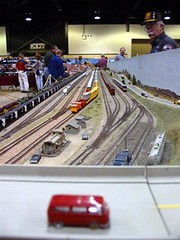
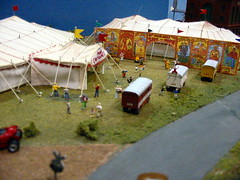
CapCity owns two modules that form a circus scene. This is the corner module with the Big Top, trailers, clowns and crowd. Never mind the 3-track mainline with frequent trains!
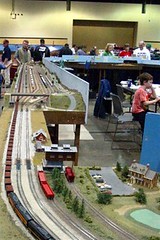
Also, that's the Boy in the orange shirt. He was unhappy about something, probably that his mean parents wouldn't buy him that shiny new train thing for $50. The Boy has trains in lots of different sizes, including an HO layout (4'x4' loop) and Lego trains. Here's a Lego layout he set up in the living room one time. See how much happier he is when he gets his toys?
Thanks for asplainin, Mom. I still don't gets it, but I thinks I see where I stole the tree from! - Victor